“If you are born poor, it’s not your mistake. But if you die poor, it’s your mistake.” – Bill Gates
Do You Want to Achieve Financial Freedom?
Whether you are single or married, just starting out or earning well in your career, struggling with debt, looking around to increase your wealth, or if you are challenged by recent economic changes, you’ll learn and grow in this personal finance talk.
What you will discover:
– Practical Money Management Strategies
– The Steps to Financial Freedom
– The Prosperity Formula
– How to Make Money Work for You
– The Art of Building a Solid Financial Foundation
– How to Become Your Own Money Manager
– IMG Preferred Membership Benefits
*NO registration fee. As in FREE Talk, just your precious time 🙂
If you are interested to know more, feel free to contact me, and will set the appointment at your time of convenience.
Balbaleg ya Salamat! Thank you very much! 🙂
Mr. Alfie Tulagan,Financial Educator, IMG Wealth Academy
Pangasinan: The town of Calasiao prides itself as the home of the famous native delicacy called puto (steamed rice cake). For many years, puto-making has been the town’s white gold for its economic contribution. In fact, the town annually celebrates the Puto Festival to highlight the gains of puto-making as one of its revenue earners.
However, there is another industry that is less celebrated but is just as important an income-earner for some people in Calasiao: charcoal-making. While the former continues to gain profit, the operation of the latter has been ordered stopped after more or less two decades of activity, due to alleged environmental and health hazards.
Elvira Diaz, a 46-year-old mother of five, is from Lumbang village and has been making charcoal, along with her husband, for almost 20 years as their primary source of living. She admitted that charcoal making had earned them much to sustain their family. One sack of charcoal costs 300 to 320 pesos. They can produce 100 sacks in a day, so that would be more than 30,000 pesos a day, less the capital expenses. “You have 10, 000 pesos as a profit,” she said. “That would be enough to sustain our children’s needs.”
Charcoal-making in Calasiao, Pangasinan is now prohibited from the moratorium issued last February 7, 2017.
Elvira and other charcoal-makers were forced to stop their enterprise when a petition was sent to the Local Government Unit of Calasiao. The petition asked that the municipality intervene because the industry was making people sick and that the operators like Elvira were already operating in large scale.
On February 7, 2017, Task Force “Oring” (Pangasinan word for charcoal), an inter-agency committee, implemented the final moratorium of charcoal production in two villages: Lumbang and Nagsaing. More than 50 families that depend on charcoal-making as a source of living were affected.
“We are affected from the charcoal making moratorium,” Elvira said. “We don’t have any other sources of living here in Lumbang village. I needed to cut the school allowances of my children as an effect.”
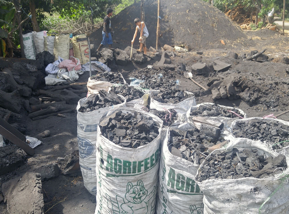
Ernesto Diaz, 54, a father of seven, from Nagsaing village, also complained about the stoppage of charcoal-making. While he stopped from charcoal making, he continues to pack charcoal that he buys from other towns to sell afterwards. He needed to do it to make both ends meet.
Ernesto Diaz, 54, manually packs the charcoal he bought from the other town following the charcoal-making ban in Calasiao, Pangasinan.
“We became even poorer when they stopped charcoal-production,” Ernesto said. “May they [LGU] fulfill their promise of helping us find an alternative source of living?”
Lilia Samonte, also a resident of Nagsaing, grumbled about having to feed their children some watercress and edible snails for meals now that charcoal-making has been stopped. “Unlike before, we can eat delicious food. Now, we eat “tuyo” (dried fish) instead of milkfish,” Lilia said.
Elvira, Ernesto and Lilia all await for the local government’s promise of livelihood assistance.
What went wrong?
Roberto Agsalud, Lumbang’s chieftain, admitted to have received a plethora of complaints from his constituents due to charcoal production. One third of the entire village population was affected, with nearby villages suffering the same. “Charcoal production draws ire from many residents, not only from our village, but also from nearby villages of Ambuetel and Dinalaoan,” Roberto said.
“The smoke is terrible; your lungs will be greatly affected,” Roberto said. “If you have asthma, you will suffer the effect more.”
Asked why it took them so long to finally put a halt to charcoal production, the chieftain said it was only now that complaints had escalated much. “There were already complaints before, but not as much as today,” Roberto said.
They even hinted to charcoal makers that they would lose their living if they will not regulate their production. They proposed for a rotational charcoal production among businessmen to ease the smoke effect but yielded negative compliance. “Those who have capital bought as much wood truckloads as funds permit to make charcoal,” Roberto said. “They became greedy.”
Prior to final closure, Ferdinand Mamaril, the head of Lumbang Charcoal Association, even agreed to follow environmental guidelines as suggested by the Community Environment and Natural Resources Office (CENRO) for their charcoal operation to continue. However, it was too late as the Task Force “Oring” decided to finally stop the operation citing environmental, health and economic reasons.
But threats of irresponsible charcoal-making are still evident. According to Task Force “Oring”, some affected businessmen have moved to other areas in Bayambang, Malasiqui, and San Carlos City. Some are subtly starting again at the backyard of the homes.
Affected charcoal-makers were given option to raise goat or cattle as an alternative source of living. The LGU has sought the help of the Department of Labor and Employment and Department of Trade and Industry for livelihood grant. The families which are into charcoal-making initially rejected the livelihood grants. They were not ready to embrace an alternative source of living. There hesitation can be attributed to the fact that income from cattle-raising will not be proportional to the income that they’re getting from charcoal production.
“We need to wait for another approval this time,” Albaño said. She assured that livelihood grants are now on the roll.
Reasons for closure
“Number one reason is health. The production area operates in a residential area, which is not allowed,” Janet Albaño, the newly designated municipal environment officer and head coordinator of Task Force “Oring” said. “Some are located in between houses, really very near residential houses.”
The Municipal Health Office cited that around 70% of the incidence of respiratory diseases in these two villages (Lumbang and Nagsaing) can be attributed to the smoke emissions from charcoal-making. Most affected are children and senior citizens.
Albaño and her team from the local government unit received indignant remarks from the affected charcoal makers. “They’re angry, cursed us, even the barangay officials received flak and threats not to be voted in the next election,” Albaño recalled as they implemented the moratorium for charcoal production.
Environmental effect was the second reason for the stoppage of the charcoal production. “This global warming has changed our climate, contributing to changes in the world,” Albaño said. “We need to bring down the level of carbon dioxide in the air.”
An environmental activist since 1997, Albaño fears that if they won’t stand on their ground of implementing the stoppage of the “irresponsible” charcoal making, the effect of global warming will be even more drastic.
Cordillera Ecological Center director Michael Bengwayan noted that charcoal production has devastating ecological effect. The most common cited impact is deforestation or the clearance of forest or woodland.
“Cutting trees can result in the loss of habitat for animal species, which can harm ecosystems,” Bengwayan said. “It will harm 70 percent of Earth’s land animal and plants that live in forests.” Since plants create oxygen and absorb greenhouses gases, large scale tree cutting contributes to global warming. He said that changing temperatures can alter which organisms can survive in an ecosystem.
Accordingly, charcoal making contributes in emitting greenhouse gases in the tropical system estimated at 71.2 million tons of carbon dioxide and 1.3 million tons of methane every year.
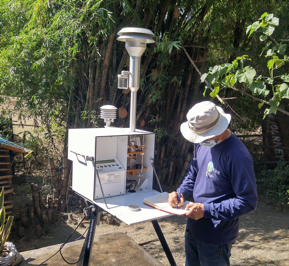
The Environmental Management Bureau from Region I also conducted a 24-hour air sampling test to Lumbang and Nagsaing. However, the result yielded negative. One local official, who requested anonymity, was dismayed at the timing when the air sampler test was conducted. “It’s just for compliance purposes,” the source said, claiming that EMB conducted the test when there was no one making charcoal. It was the period when the two-week moratorium was issued by CENRO to charcoal makers.
EMB Region 1 staff monitors the air quality in two villages in Calasiao: Lumbang and Nagsaing.
Albaño also discovered that despite regulating the issuance of permit to transport for woods to “cook”, such permits were being recycled. “One transport permit, one single use. That’s the rule,” she said. “What is happening, however, is that they [businessmen] photocopy the permits so they can bring as many truckloads of woods as possible in a day.” She lamented some loopholes conducted before and assured that it won’t happen again under her watch.
Aside from environmental and health reasons, the charcoal production in Calasiao only serves its capitalist businessmen and the families dependent on it. According to the town’s treasurer and business economic enterprise officer Chermel Poserio, not a single charcoal maker has a business registration. Poserio said they do not pay taxes to the local government unit as compared to puto-makers. Last year, the LGU collected P273,750 from cash tickets of 25 registered puto stalls, and P105,975 from business permits. The amount even excludes the personal income of individual and household puto-makers.
Responsible Charcoal Production
Bengwayan said that charcoal production can be a legitimate source of living if done in a more environment-friendly way. Aside from conducting the process away from residential places, he suggested that charcoal makers should establish fast-growing trees in woodlots that coppice or regrow easily, and the method of producing charcoal follows the ICPS (Improved Charcoal Production System).
“The efficiency of traditional charcoal production method is about 10%-22% (calculated on using oven-dry wood with 0% water content) while the efficiency of the ICPS is approximately 30%-42%,” Bengwayan explained. “As compared to traditional carbonization processes, the ICPS reduces emissions to the atmosphere by up to 75%.”
The ICPS works in two different phases. The first phase works like a traditional kiln; however, waste wood is burned in a separate box to dry the wood. The second phase involves the burning of harmful volatiles in a hot ‘fire chamber’, meaning all resulting emissions are cleaner with reduced volatiles. “The heat gained by flaring the wood gazes is used and recycled to accelerate the carbonization process,” Bengwayan explained. “Unlike traditional methods, ICPS can complete a carbonization cycle within 12 hours.”
Moving Forward
“Stop it while it is still small because once they find out that the business can thrive, authorities would have difficulty stopping it,” Albaño warned as she believes that irresponsible charcoal production exists in all other parts of the country.
Albaño recommends a strict monitoring from the issuance of permit to cut and transport woods, and the vigilance of residents to report immediately to authorities any irresponsible charcoal production they notice.
Bengwayan also promotes continuous re-greening by way of planting trees. Some trees grow slowly (20-30 years to reach full size), while others are fast growers (10-15 years).
“One and a half hectare of forest absorbs six tons of carbon dioxide and puts out four tons of oxygen. This is enough to meet the annual needs of 18 people,” he said.
However, until the needs of Elvira, Ernesto and Lilia remain unmet, they will look for ways to subsist, as far as getting their hands black and dirty again. The local government must fulfill its promise to assist affected residents by way of livelihood assistance, and prove to them that there are better ways to live outside irresponsible charcoal production. #
P.S.: This story was produced for PECOJON- Philippines; need to update for news development.
“Mainstream media is no longer in power. People now have the power to tell the message in their own way.” Riyaad Minty, head of Social Media for Al Jazeera, fired up the first plenary discussion by sharing lessons from the Arab Spring with at least 300 journalists at the East-West Center’s 2012 International Media Conference held at Yonsei University in Seoul, South Korea.
Minty, along with other reliable speakers and panelists, presented their wisdom and experience during the conference with the theme “Networked News: How New Media is shaping the stories in Asia and the Pacific.” The conference focused on the impact of social media technologies, the ways news media cover covers them, and how it transformed societies and world events.
The 2011 Arab Uprising served as a revolutionary example of how powerful new media has become. Minty said that a simple hashtag changed the course of Arab regimes that rose from the death of a Tunisian street vendor named Mohamed Bouazizi. People in the Arab region created the hashtag #sidibouzid where news of the victim’s self-sacrifice spread and flared up into a revolution.
“The power of hashtag is one of the most amazing things that happened,” Minty said. “Never before would we have thought that in such a short space of time people could have an impact that could overthrow a government.”
Citizens emerged as journalists, tweeting and live blogging, reporting their revolution through their own eyes. The role of the mainstream media, Minty said, was to put it in context for public consumption.
According to Minty, social media is not about understanding technology but about understanding people and helping people use technology.
Internet Freedom
There is much power in using social media that could make or break a person, institution, or a system. According to Evgeny Morozov, author of The Net Delusion: The Dark Side of Internet and a visiting scholar at Stanford University, who spoke via Skype during the conference, Internet can be a tool of suppression by authoritarian government or a tool of liberation.
Authoritarian rules have enforced Internet strategies that allow people to access only local sites, such as the popular Chinese microblog portal Weibo, which are easier to control than international social media like Facebook and Twitter, Morozov said.
Jeff Jarvis, director of the Tow-Knight Center for Entrepreneurial Journalism, City University of New York and author of “Public Parts: How Sharing in the Digital Age Improves the Way We Work and Live, and What Would Google Do?” told participants via Skype from US to make careful choices in using the Internet and social media, in particular.
“Technology is neither good nor bad, and it can be used by good people or bad people,” Jarvis said. It could be used not only as a medium of content but a platform for relationships among people as well as the “wisdom of the crowd” citing Wikipedia as an example.
He also noticed that people seem to be quick to push for regulation of the Internet. “It’s far too soon to regulate the Net. We have to explore its benefits. To believe we can hold back the New and hold back its progress is foolish,” he said.
Innovations in the Digital Age
CEO and Executive Editor Maria Ressa also shared some digital innovations in the Philippines with their start-up social news network Rappler.com. She emphasized the interplay of a mood meter in every story posted on their website using various social media platforms. Accordingly, 80 percent of people’s decisions are influenced by emotions, and they’re using it to stimulate interactions.
There were also workshops on how to maximize social media in storytelling and news reporting. Having a Twitter or a Facebook account means nothing without a deeper understanding of social media, said Michael Villanueva, also of Rappler.com. One should know how to harness the power of social media, by having the right tools and knowing how to use these tools.
An emerging trend of mobile journalism (mojo) could now be observed because of the existence of modern smartphones like the Iphone. These allow not only journalists, but also netizens, to record, edit audio and video on the screen of the phone and send a complete package to the newsroom from the field. That’s why even in the Philippines, citizen journalism, through what broadcast networks call “youscoopers” or citizen patrollers, operates just the same as what professional journalists do.
The power of social media could also extend beyond politics. Social media platforms have been used to further one’s cause and propaganda. According to American political strategist Joe Trippi, who seems to be convinced to use social media for the upcoming US elections, “power is shifting to the people, to the bottom-up participatory democracy. There’s a massive shift not just how in how we communicate, but in who has the power to communicate.”
Trippi demonstrated statistics on FB and Twitter popularity, noting that FB grew from 100 million users in 2007 to 900 million users toda. Moreover, Twitter had 2 million users by the end of the American presidential campaign of Barack Obama in 2008. It has 160 million users worldwide today.
Traditional Media to Digital Age
The seemingly-escalating popularity and importance of social media poses, on the other hand, a challenge to those operating in the traditional media. While TV remains to be the top news source, according Rappler.com, social media ranks third, very close to Newspaper, which is second top news source worldwide, which operates on a traditional journalism environment.
Panelists from news outlets like Editor-in-Chief Anna Pamintuan of The Philippine Star and Eric Owles, chief online producer at The New York Times, recognized the need to strategize for them to survive. One thing is to share content across many digital platforms, urging the traditional journalists to be more digitally savvy, Pamintuan said. It should also offer customizable news apps and digital replicas of the printed edition, she added.
Owles of The New York Times believed that readers are willing to pay for online journalism. He discounted the notion that only businesspeople are willing to pay for online content. “Innovative journalism is the remedy for attracting users who are hesitant to pay,” he said.
Yoichi Funabashi, former editor-in-chief of Asahi Shimbun and chairman of the Rebuild Japan Initiative Foundation, said that social media “are good at providing raw media, but still weak at contextualizing the data.” Participants are challenged to maximize social media with utmost care and responsibility, providing context to what is really happening.
Al Jazeera’s Riyaad Minty offered this formula for a new definition of journalism:
(info – noise) + context = accurate reporting.
It is only through this that the power of social media becomes the power of professional and responsible journalism. #
Alfie Tulagan has been a broadcast journalist for more than a decade in North Central Luzon, Philippines. He has been exposed to various beat assignments but found covering disasters and conflict the most challenging ones.
Because of his dedication, integrity and excellence in his craft, various academic institutions in the region have recognized him as the best field reporter several times in the span of 10 years. He has been a frequent speaker/lecturer/judge to various schools press conferences and youth leadership trainings and seminars.
He left the media industry last October 2018 to continue his public service through a different platform by running as a municipal councilor (legislator) in hometown Malasiqui, Pangasinan. If fortunate to win in the May 2019 election, he will continue his advocacy on media literacy, disaster preparedness, youth empowerment and education.
He is a proud product of Don Pedro Elementary School and Malasiqui National High School in Malasiqui, Pangasinan. He finished his BA Communication and MA Language and Literature degrees at UP Baguio. He finished a Certificate in Online Journalism through a sponsored program by RNTC-Netherlands. He is now studying law at the University of Pangasinan.
5-POINT LEGISLATIVE AGENDA:
1. Strengthen the Filipino Family through Spiritual, Moral and Social development
I intend to introduce legislation that shall enhance the spiritual and moral fibers of my community. I would like to propose, if there is none yet, a resolution creating the establishment of a “Character Town” wherein each month, characters or values with Pangasinan language translation will be highlighted in the community. Through these, we will all be reminded that we should live up to the characters, Christian discipline, and ideals of a noble Filipino family in Malasiqui.
I also intend to introduce legislation that shall support and enhance family welfare, and important issues that have significant impact on the family such as job generation, overseas Filipino workers and responsible parenthood and family planning.
We will continue to seek the wisdom, guidance and participation of our elders and senior citizens. They have more to contribute despite their age.
2. Empower the Filipino Youth through Education, Social Awareness and Knowledge Generation
The youth comprises the overwhelming majority of the population. It is my ardent desire and inspiration to support the youth in their quest for quality and relevant education. I shall encourage the less fortunate youth and those living in the countryside to continue their studies. I shall find ways to help them in any possible way.
3. Empower community against disaster and calamity
I shall initiate the legislation of ordinances that will enhance the capability and resiliency of our community in times of disaster and calamity. As a country battered by at least 20 typhoons every year, we have to enhance the capability of our responding emergency workers through equipment upgrade and manpower training. We also need to educate the community by knowledge and information on the practical ways on how to be prepared at all times, thus reducing casualties and liabilities.
4. Advocate Media and Financial Literacy
Media literacy is an important advocacy in this Digital Age. I shall introduce legislation and advocate the responsible use of all kinds of media for the benefit of the community. There are many ways on how to harness the power of media, and the key is to use it the positive and responsible way. Media literacy can tackle various issues on cyber bullying, depression, suicide and mental health. If we have this media literacy, the minds and consciousness of our citizen will be safeguarded against the evil threats of irresponsible media usage.
Moreover, I shall also integrate a program where we can advocate financial literacy so that members of the community will be educated on the proper spending, budgeting, and investing to build financial solid foundation.
OFW, PWD, AGRICULTURE, HEALTH Programs
I shall find ways to honor the hardships and contribution of our unsung heroes, the OFWs, by crafting a resolution that will support programs for OFWs and their families left behind.
I shall also advocate programs to uplift the life and welfare of the Persons With Disabilities (PWDs). I believe that each person has something to contribute in the betterment of our society.
Health programs will be a priority for all ages.
With all these agenda, I still prefer to listen to the concerns and pleas of our people. Thus, these legislative agenda will definitely change and evolve as I continue to listen to the heartbeat of the members of my community.
Also, I could not do it alone. I have always believed that the task of nation building does not rely on a single leader posing as a messiah, but by the concerted effort of every responsible and loving Filipino citizen, who aims to see a nation that s/he can be proud of.
Thank you very much. Maraming Salamat po! Baleg Ya Salamat Kabaleyan!
SUMMARY LEGISLATIVE AGENDA OF ALFIE TULAGA
A griculture: We need to attain food stability and help our farmers cope with the challenges of farming and agriculture in general.
L iteracy: I will advocate Media and Financial Literacy among youth and members of the community. I will support Pangasinan language development.
F amily and youth Development: Strengthen family and youth core values through Spiritual, Moral and Social development.
I ntegration of various programs (health, wellness, awareness) that will benefit OFW and their families, PWD, Senior Citizen and other sectors of society.
E mpower community against disaster and calamity; target poverty reduction and employment generation.
Around 100 hectares of rice farms have been affected by various pests and diseases in Alaminos City, Pangasinan.
Some portions of farms in Amandiego village are infested by brown planthoppers (BPH), locally known as “sepsep.” BHPs damage rice directly through feeding and transmitting viruses.
Other areas have shown signs of infection caused by bacterial leaf blight, leaf streak and rice blast.
Bacterial blight causes wilting of seedlings and drying of leaves. Leaf streak causes browning and drying of leaves while blast is caused by the fungus Magnaporthe oryzae which can affect leaf, collar, node, neck, parts of panicle and sometimes leaf sheath. It occurs in areas with low soil moisture, prolonged periods of rain shower and cool temperature in daytime.
According to Gester Tolentino, agriculturist II of Alaminos City, most of the affected farm lands are infected by pests and diseases triggered by sporadic weather condition.
“It depends on the susceptibility of the plants or the rice. If the palay is susceptible and pests are not controlled, rice farms will be affected,” Tolentino said.
Video details here (Balita Pilipinas Ngayon, GMA News TV):
Marlon Bantolini, a farmer, became emotional as he explains how his rice farms turned into hopper burn. He expects no profit this cropping season.
“They are like black ants. I can’t control it. After the rain, we checked the farm. It was all infected,” he said in local language. He hopes for better cropping opportunity next planting season.
According to Arceli Talania, city agriculturist, there are 100 hectares affected so far.
“Effects are varied, some are pest-infected, others are caused by diseases,” Talania said.
Their office will provide seed subsidies for the affected farmers. #
PANGASINAN: The San Roque dam started releasing water from its two gates since Saturday noon due to bad weather brought by Typhoon Ineng. The National Power Corporation issued a notice of dam discharge operation since the water elevation has reached its spilling level of 280 meters above sea level (masl).
According to Tommy Valdez, San Roque Power Corporations’ vice-president for corporate social responsibility, the water release is considered a precautionary measure to prevent massive flooding and further damages in Pangasinan.
“The water level keeps on increasing. So to balance that or to pre-empt the sudden increase of water level, nag-instruct sila ng release ng tubig [they instructed water release],” Valdez said.
As of Tuesday, around 700 cubic meters of water per second are being released from the dam.
Accordingly, the Agno River system can withstand the amount of water being released from the dam. It is not supposed to trigger floods along the 18 towns and cities traversing Agno River. However, Valdez advised the local disaster units to monitor other river systems in the province.
Meanwhile, the Pangasinan Disaster Risk Reduction and Management Office remains on red alert. The office monitored the emergence of flood in towns of Calasiao, Sta. Barbara and Bayambang.
“Kung walang sasalong dam dito, yung mga pag-uulan na nangyayari sa Cordillera region ay babato sa Sinocalan River yun, galing Mt. Ampucao [Without the dam, all the rainwaters in the Cordillera Region will flow from Mt. Ampucao down to Sinocalan River],” Avenix Arenas, PDRRMO spokesperson said.
Because of flood, 10 barangays [village] in Calasiao towns are flooded. Some roads are impassable.
Residents are advised to take precautionary measures, like pre-emptive evacuation if need be. Water search and rescue teams and equipment are readily available.
Meanwhile, some students brace the flooded areas just to attend class. #
Dry spell continues to affect hundreds of farmers in Malasiqui town in Pangasinan.
Rain-fed dependent farmers fear that their farm lands will suffer for lack of water irrigation.
Jimmy Cariño, a farmer, now uses water pump to save his farm lands from drying up. Withered rice fields are already evident.
“Our farms are already affected. Farm lands have dried up. If these lands will not be irrigated, all our crops will be wasted,” he said.
Soil cracks are common in the area due to El Niño phenomenon.
He hopes the effect of the monsoon rain will somehow benefit their farm lands.
“If there is a typhoon, definitely there is rain. We just want the rain, not the wind,” he added.
Even those who planted hybrid seeds felt the effect of drought.
Carlito Gante, a hybrid seed provider, observes the massive effect of the dry spell in Western Pangasinan, particularly in the agricultural areas of Burgos and Dasol towns.
“Rain water is not enough. Even though we had monsoon rains and typhoons the past month, the effect of El Niño is massively unexpected,” Gante said.
In Malasiqui town, there are more than 7,000 farmers. More than 6,000 hectares are intended for palay production. Province-wide, around 180,000 hectares are agricultural lands.
According to Jovelito Alamar, municipal agriculturist, around 3,500 hectares of rice farms are affected by the dry spell. However, agricultural areas covered by the National Irrigation Administration are exempted are able to survive.
“About 3,500 hectares are affected, mostly from rain-fed dependent areas. Water from communal irrigation is not enough,” Alamar said.
Moreover, about 1,400 hectares of farms lands in the province are also affected by various pests such as army worms, rice blasts, and bacterial leaf blight.
According to Dalisay Moya, provincial agriculturist, various pests occur due to the effect of dry spell. However, if these plants are growing in their early stages, rice farms can still survive. Farmers are advised to use insecticides.
According to the provincial agriculture office, less than 50% of the entire Pangasinan agricultural land is affected by drought.
Farmer groups have already convened for possible interventions. They are asking for more water pumps to be leased for farmers, as some do not have their own water facilities. They have also requested for possible cloud seeding, a form of weather modification intended to increase precipitation.#
San Carlos City, Pangasinan: Parents here are warned to strictly monitor the whereabouts of their children going to school, even after classes. With the latest report of alleged kidnapping of a 10-year-old, grade four pupil, who happened to escape from three perpetrators, fears mounted among parents and authorities. Thus, vigilance and precautionary measures are strongly advised.
New face, new look, same brand of Serbisyong Totoo!
Part of GMA News and Public Affairs’ move to fortify its stance as the most trusted news organization in the Philippines, all its regional stations nationwide will adopt the title of the national newscast ‘24 Oras’ plus the name of the coverage area.
Thus, Balitang Amianan, the undisputed regional news program in North Central Luzon for more than six straight years since its first airing in 2008, has followed suit and carried 24 Oras North and Central Luzon as its new title!
Logo taken at 24 Oras NCL Facebook Page
This major re-branding is part of 24 Oras’ re-launch last Nov. 10, with veteran broadcasters Mike Enriquez and Mel Tianco welcoming Vicky Morales as their newest co-anchor.
For 24 Oras North Central Luzon, CJ Torida and Joyce Segui remain as main anchors, backed up by its new roster of field reporters.
THE NEWS TEAM (Photo taken at Facebook Page 24 Oras North Central Luzon)
“We are re-introducing our regional newscasts not only to give our audience an improved visual experience but more importantly to also make a clear statement that GMA’s regional newscasts and the nationwide ’24 Oras’ share the same identity and mission which is to deliver balanced, unbiased news and without vested interest whatsoever. As we say it in Filipino, ‘walang kinikilingan, walang pinoprotektahan, Serbisyong Totoo lamang,'” says Cel Amores, Assistant Vice-President and Head for GMA Regional News and Public Affairs.
From Monday to Friday, catch the all new 24 Oras newscasts over seven GMA regional stations in Dagupan, Cebu, Davao, Cagayan de Oro, Iloilo, Ilocos and Bicol. #
DAGUPAN CITY: At least 14 classrooms are submerged into water due to perennial rains the past days in Bonuan Boquig Elementary School.
Knee-high flood had caused suspension of classes for six sections of Grade 3 for a day. But school authorities developed a shifting schedule and room maximization to continue classes for affected pupils.
Principal Manuel Ferrer feared that flood problems may take more or less a month long, if weather condition continues to worsen.
Barangay Council and City Engineering Office have inspected the area. They are now looking into solutions, both immediate and long-term. Construction of a functional drainage system is deemed to address the problem.
Despite these challenges, pupils remain hopeful and inspired to continue their studies.